prideQC documentation#
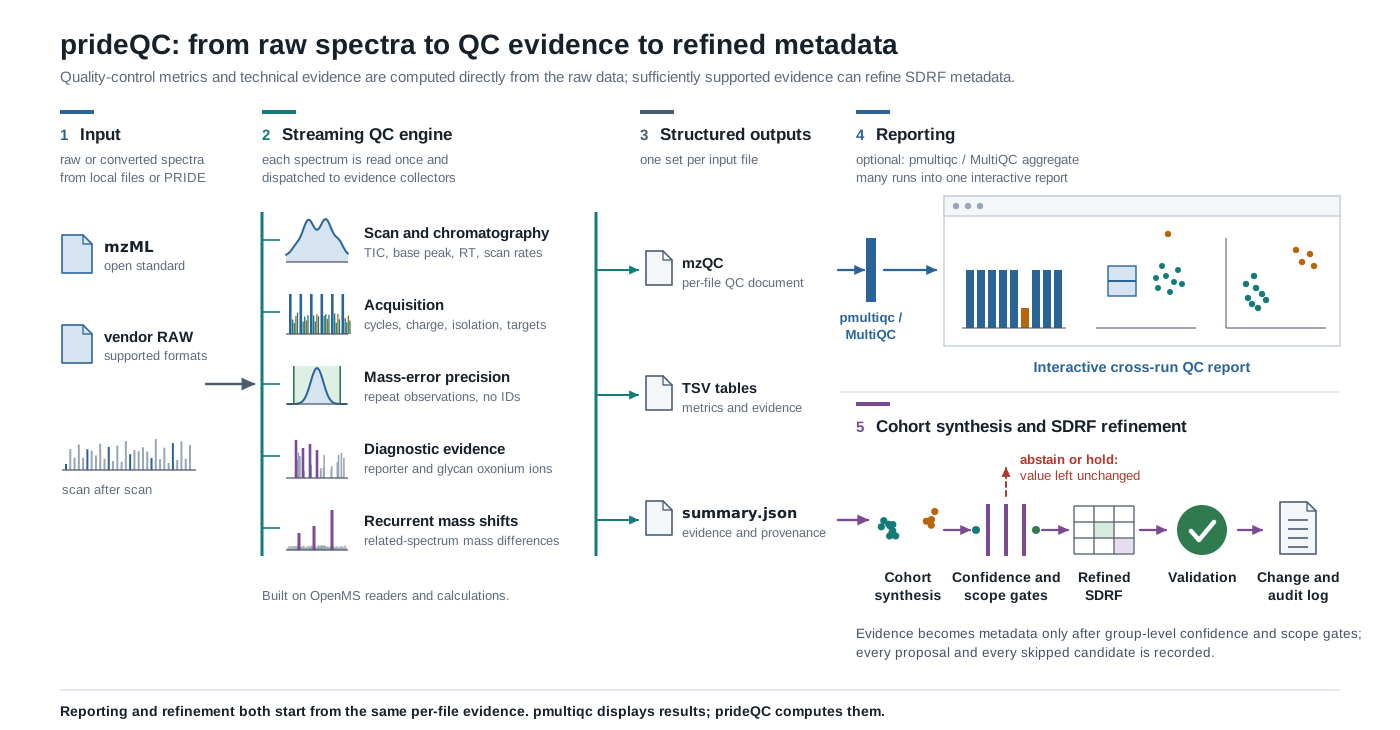
prideQC analyzes raw data into per-file QC evidence. The resulting mzQC files can be summarized with pmultiqc, while structured run summaries feed cohort-level SDRF refinement. Uncertain proposals can abstain.#
Install prideQC, analyze raw data, inspect outputs, and refine an SDRF.
See what prideQC measures from spectra and how the evidence is represented.
Understand mass-error estimation and recurrent neutral-mass-shift scouting with synthetic examples.
Generate interactive study-level QC reports with pmultiqc / MultiQC.
Learn how run-level QC evidence is synthesized into conservative, auditable metadata proposals.
Reference the main prideQC commands and options.
What prideQC is designed to do#
prideQC connects two tasks that are usually handled separately:
Compute reproducible QC evidence from raw mass-spectrometry data.
Use sufficiently supported evidence to refine technical SDRF metadata.
The first task is always primary. Metadata refinement is downstream of the measured QC evidence and can abstain when the evidence is incomplete, ambiguous, or inconsistent.
Core capabilities#
scan and chromatogram metrics
acquisition characteristics
peak-type and diagnostic-ion evidence
structured per-file summaries
precursor mass-error precision
fragment mass-error precision
conservative tolerance suggestions
explicit support and diagnostics
recurrent related-spectrum neutral-mass shifts
OpenMS / UniMod mass-compatible candidates
ambiguity and support retained explicitly
cohort synthesis across files
confidence-gated SDRF proposals
validation, provenance, and audit artifacts
optional adjudication for unresolved cases
Documentation map#
External resources#
prideQC source: https://github.com/PRIDE-Archive/prideQC
PRIDE Archive: https://www.ebi.ac.uk/pride/
OpenMS: https://www.openms.de/
pyOpenMS: https://pyopenms.readthedocs.io/
pmultiqc: https://github.com/bigbio/pmultiqc
MultiQC: https://seqera.io/multiqc/
SDRF-Pipelines: https://github.com/bigbio/sdrf-pipelines